

Hakim Ali Zardari Biography, the former Sardar of Zardari Tribe in Sindh
Hakim Ali Zardari, also known as Mir Hakim Ali Khan Zardari, was a Pakistani politician, landlord, businessman, cinema owner, and film distributor from Sindh. Hakim Ali Zardari father of Asif Ali Zardari, the President of Pakistan, but Hakim Ali Zardari had his own identity long before his son became a national political figure.
He belonged to the Zardari family of Nawabshah, a well-known landowning family in Sindh. His life was linked with agriculture, business, cinema, and politics. He lived through some of the most important political periods in Pakistan’s history and remained connected with the Pakistan Peoples Party for many years.
History of Hakim Ali Zardari
Birth and Family
Hakim Ali Zardari was born in 1930 in the Nawabshah region of Sindh, in the village of Fatohal or Fatuhal Zardari. His father was Haji Mohammad Hussain Zardari. The Zardari family was respected in the area because of its land, tribal background, and local influence.
In rural Sindh, landowning families often played an important role in society. They were involved not only in farming but also in local leadership and politics. Hakim Ali grew up in this environment, where family position, public dealing, and community respect mattered a great deal.
Education
Hakim Ali Zardari received his early education in his village. Later, he studied in Nawabshah, Hyderabad, and Karachi. This gave him exposure to both village life and city life. His education and experience helped him understand business, public affairs, and politics.
Business Career
Farming and Business
Hakim Ali Zardari first looked after farming and family lands. Later, he moved into business, especially in Karachi. At that time, Karachi was growing fast and becoming a major centre of trade, culture, and entertainment. Hakim Ali used this opportunity to build his business interests.
Cinema and Film Industry
One of the most important parts of Hakim Ali Zardari’s business life was his connection with cinema. He owned Bambino Cinema in Karachi, which became one of the city’s famous cinemas. He was also linked with Scala Cinema and film distribution.
Bambino Cinema was well known during the golden period of Pakistani cinema. It attracted many people and became a popular entertainment place. Hakim Ali was also involved in Sindhi and Urdu films. He is said to have produced a Sindhi film called Soorath. His work in the cinema industry made him different from many traditional landlords, because he was active in both rural and urban life.
Political Career
Beginning in Local Politics
Hakim Ali Zardari started politics at the local level. In 1965, he was elected to the District Council of Nawabshah. This was an important first step in his political journey. It gave him a chance to work with people directly and strengthen his position in local politics.
During the 1965 presidential election, he supported Fatima Jinnah against General Ayub Khan. This showed his early support for democratic politics and his opposition to military rule.
Joining the Pakistan Peoples Party
In 1967, Zulfikar Ali Bhutto founded the Pakistan Peoples Party. Hakim Ali Zardari joined the PPP and became one of its important figures in Nawabshah. The PPP became very popular in Sindh because it spoke about people’s rights, social justice, and democracy.
In the 1970 general election, Hakim Ali Zardari was elected to the National Assembly from Nawabshah on a PPP ticket. This election was a turning point in Pakistan’s politics. Hakim Ali became part of the first major group of PPP parliamentarians under Zulfikar Ali Bhutto.
Parliamentary Role
Hakim Ali Zardari served in the National Assembly more than once. He was elected in 1970 and later returned to parliament in 1988 and 1993. He also served as chairman of the Public Accounts Committee, an important parliamentary committee that reviews government spending.
His role in parliament showed that he was not only a local politician but also a national political figure. He remained active during difficult political times, including the years after General Zia-ul-Haq imposed martial law in 1977.
Connection with the Bhutto Family
A Political Marriage
Hakim Ali Zardari’s family became nationally famous when his son Asif Ali Zardari married Benazir Bhutto on 18 December 1987. This marriage joined the Zardari family of Nawabshah with the Bhutto family of Larkana.
The marriage had great political importance. After it, the Zardari family became closely connected with the future of the Pakistan Peoples Party. Hakim Ali became one of the senior elders of the Bhutto-Zardari family.
Family Influence
Hakim Ali Zardari’s children also became active in politics. His children include Asif Ali Zardari, Faryal Talpur, Dr Azra Fazal Pechuho, and Fauzia. Asif Ali Zardari became President of Pakistan, while Faryal Talpur and Dr Azra Fazal Pechuho became important political figures in Sindh.
Controversies and Legal Cases
Hakim Ali Zardari’s name was also linked with legal cases and corruption allegations during the 1990s and early 2000s. Some cases were related to property, business dealings, and assets. In some matters, lower courts convicted him, but higher courts later overturned important convictions.
His supporters believed these cases were politically motivated and were used to target the PPP and the Zardari family. His critics, however, saw them as part of the corruption controversies of that time. Because of this, his public image remained mixed.
Later Life and Hakim Ali Zardari Death
In his later years, Hakim Ali Zardari suffered from serious health problems. He had kidney and lung issues, strokes, and brain-related complications. Due to poor health, he stayed away from active politics. Chief Election Commissioner Hamid Ali Mirza Condoles the Death of Hakim Ali Zardari

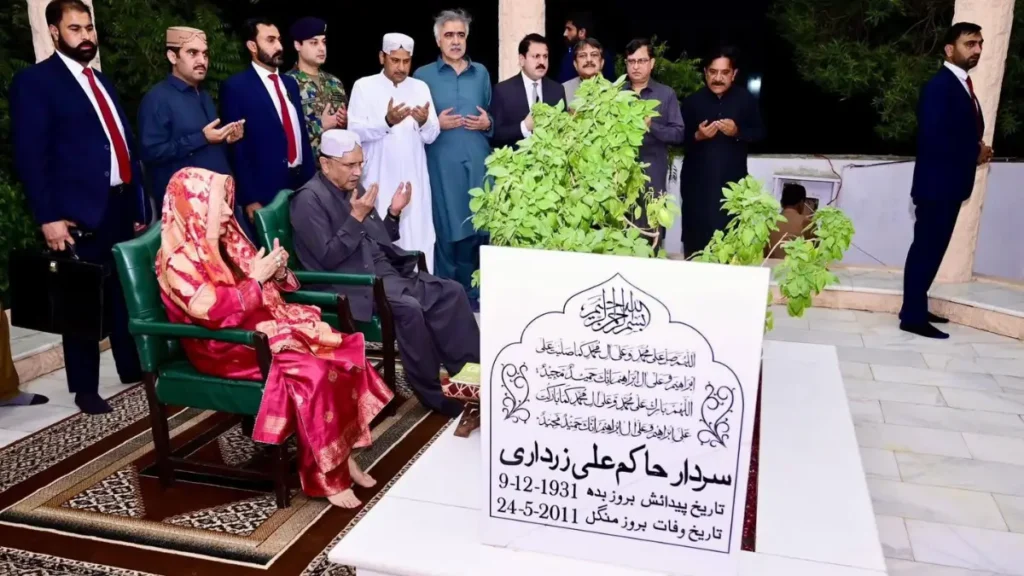
He died on 24 May 2011 at the Pakistan Institute of Medical Sciences in Islamabad. He was 81 years old. He was buried in the Zardari family’s ancestral graveyard at Balo-jo-Qubbo near Nawabshah.
Map Location of Baloo ja Quba Graveyard
Legacy
Hakim Ali Zardari lived a life full of business, politics, influence, and controversy. He started from a landowning family in rural Sindh, entered Karachi’s business and cinema world, and later became a member of Pakistan’s parliament.
His legacy is closely linked with the rise of the Zardari family in Pakistani politics. Supporters remember him as a practical and experienced political figure. Critics remember the controversies connected with his name. Still, his role in building the social, business, and political base of the Zardari family remains important in Pakistan’s political history.
Frequently Asked Questions About Hakim Ali Zardari
Who was Hakim Ali Zardari?
He was a Sindhi political figure, landowner, businessman, and cinema owner. He is also remembered as the father of Asif Ali, the current President.
Where was he born
He was born in 1930 in Fatohal, a village in the Nawabshah region of Sindh.
What kind of family did he come from?
He came from a landowning Zardari family with influence in rural Sindh. Their position came from agriculture, tribal links, and local leadership.
What was his father’s name?
His father was Haji Mohammad Hussain Zardari.
What was his main business?
His best-known business was cinema. He owned Bambino Cinema in Karachi and was also linked with film distribution
Why was Bambino Cinema famous?
Bambino Cinema was one of Karachi’s popular theatres during the strong years of Pakistani film. It became a known entertainment spot in the city
Did he work in films?
Yes. Along with cinema ownership, he was connected with film distribution and Sindhi cinema. He is also associated with the Sindhi film Soorath.
When did he enter public life?
His public career began in the 1960s. In 1965, he was elected to the District Council of Nawabshah.
Which party did he join?
He joined the Pakistan Peoples Party after Zulfikar Ali Bhutto founded it in 1967. Later, he also spent time with the National Democratic Party before returning to the PPP.
Did he support Fatima Jinnah?
Yes. During the 1965 presidential election, he supported Fatima Jinnah against General Ayub Khan
Was he elected to the National Assembly?
Yes. He became a member of the National Assembly in 1970 and later returned in 1988 and 1993.
Which parliamentary post did he hold?
He served as chairman of the Public Accounts Committee, a key body that examines government spending.
How was he connected to Benazir Bhutto?
His son Asif Ali Zardari married Benazir Bhutto on 18 December 1987. After that marriage, the Zardari family became closely linked with the Bhutto family.
Who are his children?
His children include Asif Ali Zardari, Faryal Talpur, Dr Azra Fazal Pechuho, and Fauzia.
Why is he remembered in Sindh’s politics?
He helped build the Zardari family’s public standing through land, business, and political work. His family later became one of the strongest groups within the PPP in Sindh.
Was his career controversial?
Yes. His name appeared in accountability cases and corruption allegations. Some convictions were later set aside by higher courts.
What made him different from other landlords of his time?
He was not limited to land and village politics. He also entered Karachi’s cinema business, worked in film distribution, and became part of national politics.
When did he die?
He died on 24 May 2011 in Islamabad after a long illness.
Where is he buried?
He was buried in the Zardari family graveyard at Balo-jo-Qubbo near Nawabshah.
What is his legacy?
His legacy lies in three areas: Sindh’s landed politics, Karachi’s cinema culture, and the rise of the Bhutto-Zardari political family.
Who was Hakim Ali Zardari’s wife?
He married to Bilquis Sultana, who was the mother of Asif Ali Zardari. He also married to Zareen Ara Bukhari, a highly educated literary figure from the famous Bukhari family. Zareen Ara Bukhari is often remembered as the stepmother and foster mother of Asif Ali Zardari and his siblings.